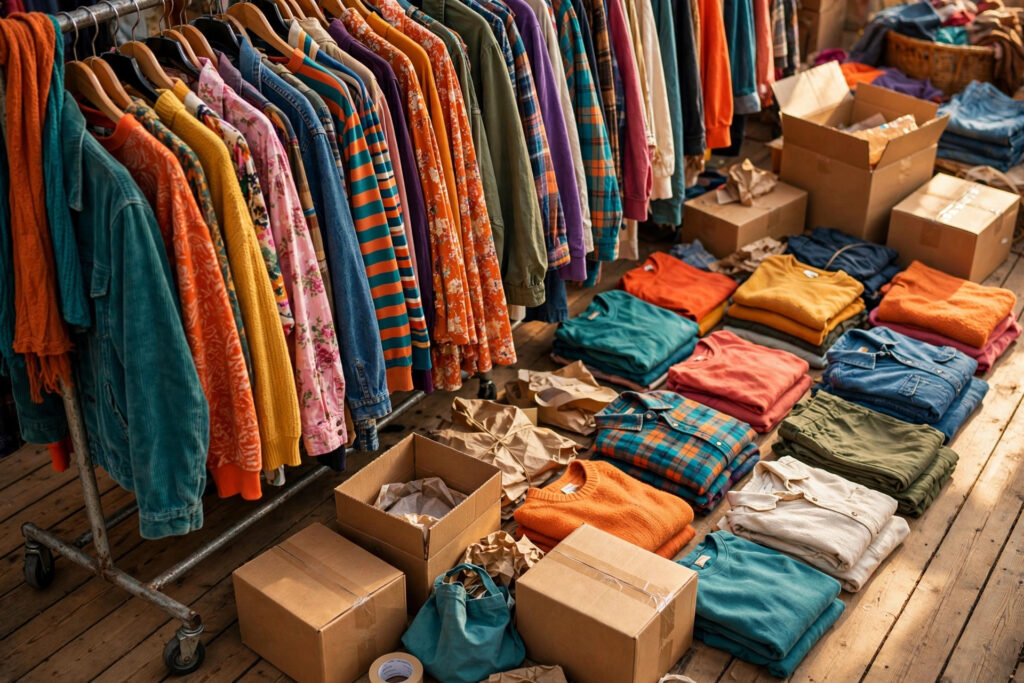
You found a barely-worn Free People dress at Goodwill for $4.99 — now where do you sell it for maximum profit? eBay reaches the biggest audience, Poshmark simplifies shipping, and Depop charges the lowest fees in 2026. The right choice depends on what you’re selling and how much work you’re willing to put in.
Fee Comparison: The Numbers That Matter
Fees decide how much of your thrift-store margin you actually keep. Here is how the three platforms stack up, according to 2026 fee comparisons published by seedingserendipity.com, voolist.com, and flipprofithq.com:
| Platform | Fee structure | You keep on a $30 sale* |
|---|---|---|
| Depop | No selling fee; 3.3% + $0.45 payment processing | ~$28.56 |
| Poshmark | Flat $2.95 under $15; 20% on $15 and up | $24.00 |
| eBay | 13.6% in most categories + $0.30–$0.40 per-order fee | ~$25.52–$25.62 |
*Approximate, before shipping. Poshmark’s $2.95/$20% split comes from Poshmark’s own fee page, summarized by flipprofithq.com. eBay’s 13.6% rate is reported by seedingserendipity.com and flipprofithq.com.
The math tells a clear story. On a $30 thrifted jacket, Depop leaves you roughly $4.50 more than Poshmark — per flip. Sell fifty pieces a month and that gap adds up to real money. eBay sits in the middle on fees but brings the largest buyer pool, which can mean faster sales on in-demand items.
One eBay exception worth knowing: sneakers sold for $150 or more fall to an 8% fee with no per-order charge, according to flipprofithq.com. If you flip heat from thrift stores or estate sales — Jordans, New Balance 990s, vintage Nikes — eBay undercuts both rivals on high-ticket kicks.

How Each Platform Actually Works
eBay: The Auction House With Everything
eBay is the oldest and largest of the three, and it shows. Listings can run as auctions or fixed-price “Buy It Now” sales, and the category system covers far more than fashion — electronics, collectibles, home goods, vintage toys. For a thrifter whose hauls range from Pyrex to Patagonia, eBay is the only platform that can sell all of it in one store.
The tradeoff is complexity. You handle your own shipping labels, packaging decisions, and returns policy. Sellers with a track record qualify for discounted shipping rates and promoted-listing tools, but new sellers start from zero. eBay’s buyer base skews older and more international than the other two, which is a genuine advantage for niche vintage — a 1970s concert tee or an obscure Japanese denim brand finds its audience here faster than anywhere else.
Poshmark: The Social Closet
Poshmark is built like a social network for clothes. You “share” listings to your followers and to themed parties (like “Best in Shoes” or “Vintage Vibes”), and the feed rewards constant activity. The famous $5.99 flat shipping label is prepaid and printed at home — you never touch a scale or a post-office calculator.
That simplicity is the whole pitch: photograph it, describe it, ship it in anything, done. The platform’s 20% cut on sales of $15 and up is the steepest of the three, but the fee page on Poshmark confirms it’s all-inclusive — no payment processing add-on, no listing fee. Poshmark also protects sellers by holding funds until the buyer accepts (or three days pass), which cuts down on scam chargebacks.
The catch, beyond fees: buyers pay that $5.99 shipping on every order, which makes cheap items harder to move. A $6 thrifted tee becomes a $12 purchase before your cut. Poshmark shines for items priced $20 and up — contemporary brands like Zara, Lululemon, and Free People, plus mid-tier vintage.
Depop: The Gen-Z Marketplace
Depop runs on phone-first listings and a streetwear-heavy aesthetic. The listing process takes under a minute, and the 2026 fee structure — no selling fee, just 3.3% plus $0.45 in payment processing, according to seedingserendipity.com and voolist.com — is the cheapest of the three for US sellers.
Depop’s search rewards trending keywords and styled photos over polish. A flat-lay on a bedroom floor with the right tags (“Y2K”, “fairycore”, “90s slip dress”) can outsell a studio-quality shot. The audience skews younger and trend-driven, so this is the place for thrifted Y2K pieces, band tees, cargo pants, and anything that photographs well in a mirror selfie.
The downside is scale and support. Depop’s buyer pool is smaller than eBay’s and less structured than Poshmark’s. Shipping is on you to arrange, though in-app label options exist in the US. And because the vibe is casual, buyers can be flakier — expect more “is this still available?” messages that go nowhere.
Who Buys What: Matching Inventory to Platform
Not every thrift find belongs on every platform. Matching the item to the audience is the fastest way to sell faster and price higher:
- eBay: vintage and collectible (band tees, single-stitch shirts, designer pieces), sneakers over $150, non-clothing thrift (electronics, media, home goods), and anything with a niche collector audience.
- Poshmark: contemporary mall brands (Zara, H&M premium lines, Aritzia), athleisure (Lululemon, Alo, Nike), handbags and shoes in the $20–$100 range, and bundles (Poshmark buyers love 3-for deals since shipping stays $5.99).
- Depop: Y2K and 90s trends, streetwear, handmade or reworked pieces, band tees, and anything under $40 with strong visual appeal.
Cross-listing the same item on all three is legal on every platform and common practice among serious resellers. The one rule: the moment it sells somewhere, delist it everywhere else immediately. Double-selling is the fastest way to earn a bad review or a policy strike.
Shipping: The Hidden Decider
Shipping is where beginners bleed profit, so pick a system and stick to it. Poshmark removes the decision entirely: one $5.99 prepaid label, up to 5 lbs, any box you have lying around. It is the lowest-effort option by a mile.
Depop lets sellers choose: offer free shipping (and eat the cost), charge a flat rate, or let the buyer pay exact postage. Weigh the item, add the packaging, and look up USPS Ground Advantage rates before you list — guessing shipping costs is how a $12 profit turns into $3.
eBay gives the most control and the most homework. Calculated shipping passes the cost to the buyer based on weight and distance, while free shipping (baked into your price) tends to rank better in search. eBay’s discounted commercial rates through its label portal usually beat walking into the post office, so print at home once you have any volume.
A $10 digital kitchen scale pays for itself in the first week. Flat poly mailers cost pennies in bulk and keep a thrifted top under 4 ounces — the cheapest USPS tier.
Picking Your Platform: A Quick Decision Guide
Still torn? Run through these questions:
- Is it worth over $150, or a collectible? List on eBay first. The audience and the 8% sneaker rate (for $150+ kicks, per flipprofithq.com) are unmatched for high-ticket items.
- Is it a trendy, photogenic piece under $40? Depop. Lowest fees and the right crowd mean you keep more of every sale.
- Is it a contemporary brand in the $20–$100 sweet spot? Poshmark. The flat label and built-in buyer protections make it the smoothest ride.
- Is it not clothing at all? eBay, full stop. Neither Poshmark nor Depop wants your vintage camera.
- Do you hate dealing with shipping math? Poshmark, always. Print the label, drop the package, done.
Profit Tips That Work on All Three
- Photograph in daylight, on a hanger or a person. Listings with clear, bright photos sell faster on every platform. A $3 white poster board from the dollar store makes a fine backdrop.
- Measure everything. Pit-to-pit, length, inseam, waist — buyers can’t try it on, so measurements prevent returns. Thrifted vintage sizing runs small; spell it out.
- Disclose flaws honestly. A tiny pull or faint stain disclosed upfront costs you $2 off the price; discovered by the buyer costs you a return and a bad rating.
- Price 10–15% above your target. Every platform’s culture includes haggling (Poshmark and Depop have built-in offer buttons; eBay has Best Offer). Leave room to say yes.
- List consistently. All three algorithms reward fresh listings. Even five new items a week keeps your closet or store visible in search and feeds.
Frequently Asked Questions
Which platform has the lowest fees for resellers in 2026?
Depop, for US sellers: no selling fee, just 3.3% + $0.45 payment processing, according to 2026 fee comparisons from seedingserendipity.com and voolist.com. eBay charges 13.6% plus a per-order fee in most categories, and Poshmark takes 20% on sales of $15 or more.
Can I sell the same thrifted item on eBay, Poshmark, and Depop at the same time?
Yes — cross-listing is allowed on all three platforms. The critical rule is to remove the listing from the other platforms the moment it sells on one, to avoid selling an item you no longer have.
Is Poshmark or eBay better for beginners?
Poshmark is easier to start: the $5.99 flat prepaid label removes all shipping math, and the interface walks new sellers through listing step by step. eBay offers a bigger audience and more categories but requires sellers to handle their own shipping and returns policies.
Do I need a business license to resell thrift store finds?
Requirements vary by location and sales volume. In the US, casual selling of personal items generally needs no license, but once reselling becomes a regular income stream, many states and cities require a business license and sales-tax registration. Check your state and local government’s small-business guidance, and keep records of every sale — platforms report seller income to tax authorities above federal thresholds.
How should I price a thrifted item I bought for $5?
A common reseller guideline is to aim for at least 3x your total cost (item + fees + shipping supplies) as a floor, then check sold listings — not active listings — for the same or similar items on your chosen platform. Price near the recent sold average, and list 10–15% higher to leave room for offers.
Before you list, it is worth doing the net math once: work out the fee percentage on your sale price for each platform, payment processing included, so the comparison above turns into what you actually keep.
This article was created with AI assistance and reviewed by our editorial team before publishing.