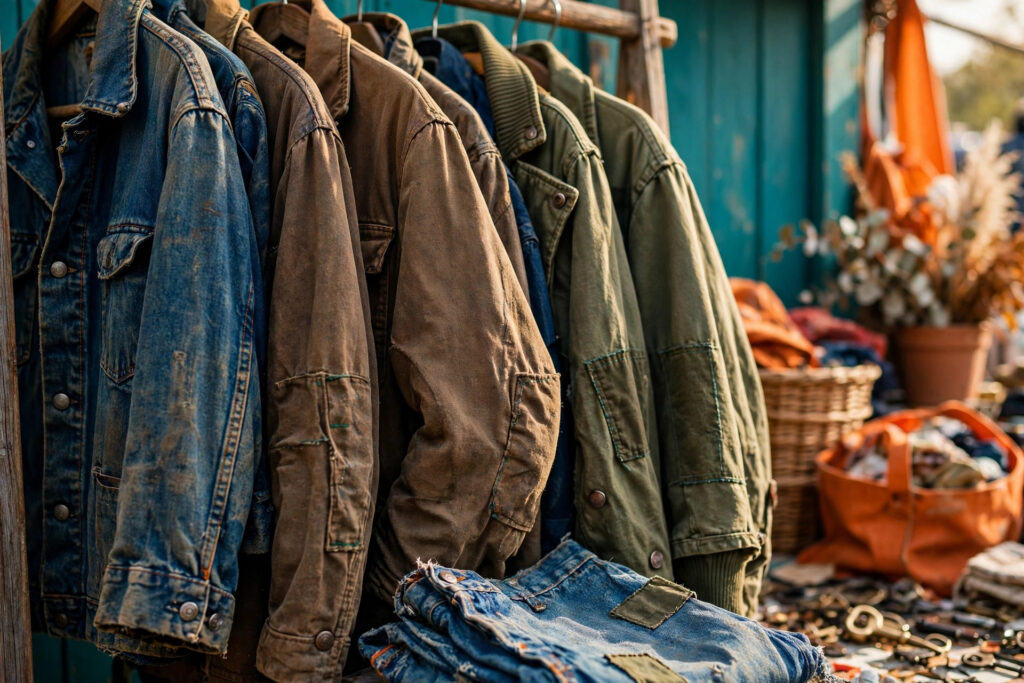
Dating vintage workwear comes down to three clues you can check in under a minute: the label, the hardware, and the fade. Care labels, union marks, zipper brands, button styles, and worn-in color patterns each point to a rough decade, so you can price, list, or keep a piece with confidence.
Start with the label, always
The neck or waistband label is the fastest date stamp on any jacket, chore coat, or pair of dungarees. Big, bold woven labels with simple block lettering usually point to earlier production. Smaller printed labels, packed with tiny text, tend to come later.
Look at the language, too. Country-of-origin markings changed over time, and a label that says “Made in U.S.A.” in proud, large type reads very differently from a later multi-language tag listing several countries. Neither one settles the date on its own. Together with the other clues, though, it starts to narrow things down fast.
No label at all? That’s a clue as well. Some earlier work garments carried minimal branding, with size stamped in ink or marked on a small separate tab. A missing label doesn’t make a piece fake. It just means the hardware and stitching have to do more of the talking.
Care labels and union marks narrow the window
Here’s a hard date worth memorizing. Care labels became mandatory on garments sold in the United States in 1971, under the FTC’s Care Labeling Rule. So a jacket with permanent care instructions sewn in was made after that point, while a similar jacket with no care instructions at all may well predate it.
That single check splits a pile in two. Sellers love to call everything “1950s,” but a care label quietly rules that out. Flip the rule around for listings, too — “pre-1971, no care label” is a concrete detail buyers can verify themselves.
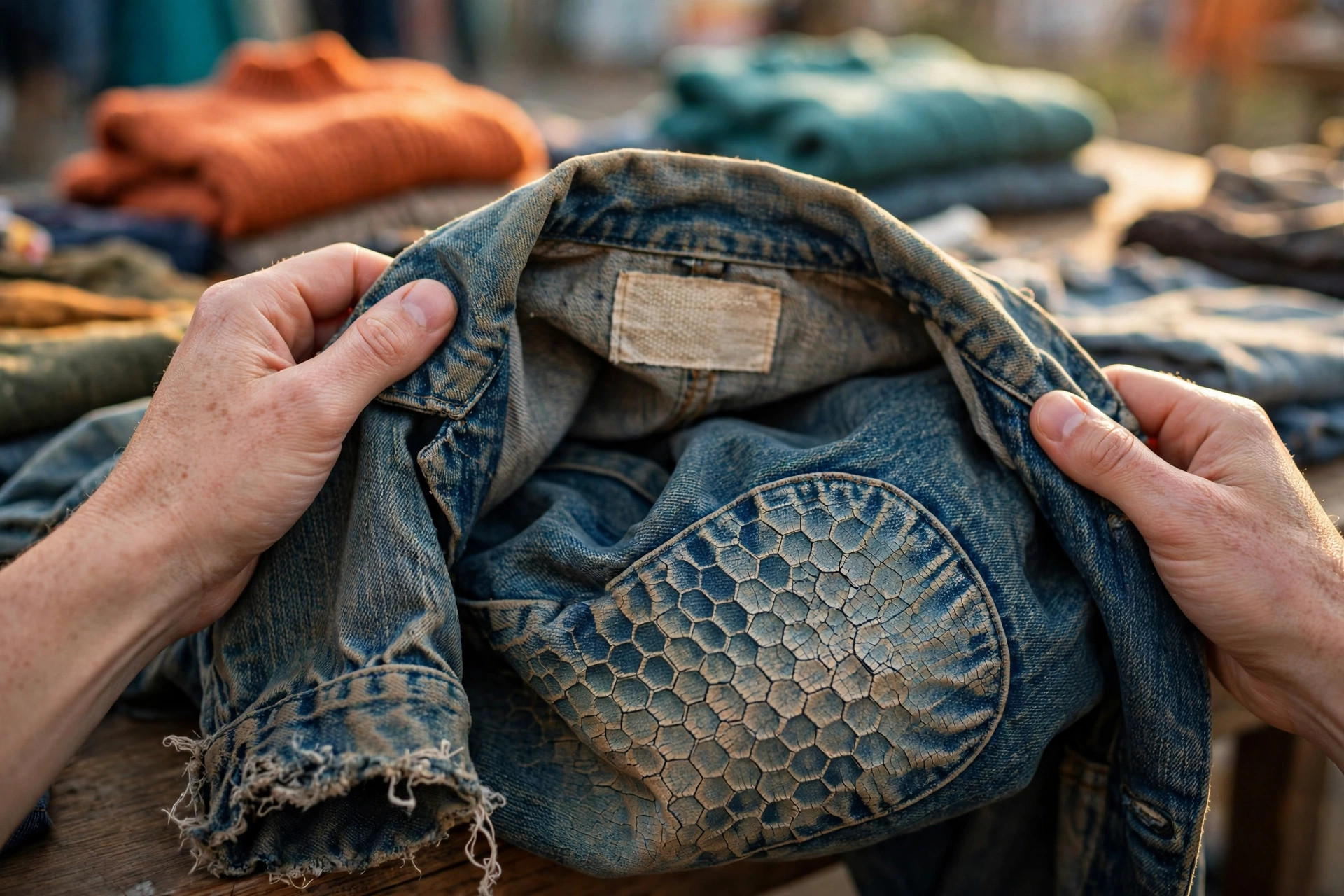
Union labels add another layer. Garments made by union shops often carry a small union bug or label, and the designs of those marks changed over the decades. The exact styles are well documented by collectors, so a clear photo of a union label lets a knowledgeable buyer cross-check the era in seconds.
Hardware tells the truth
Labels can be swapped, faded, or cut out. Hardware is harder to fake, and it rarely lies. Start with the zipper. Brands like Talon dominated earlier decades of American workwear, and zipper pulls, teeth shapes, and stamped brand names all shifted as production moved through the years.
A chunky metal Talon zipper on a work jacket suggests an older piece than a flimsy nylon coil zipper. Check the pull closely. Is the brand stamped into the metal? Is the shape simple and heavy, or thin and modern? Small details, big hints.
Labels can fade, tear, or get cut out. A zipper, a button, and a line of stitching will still tell you when a jacket was made.
Snaps and rivets deserve the same look. Branded rivets on denim, painted or unpainted, and the lettering style stamped into them changed across eras. Replacement hardware exists, of course, so one new-looking snap on an otherwise worn jacket shouldn’t rewrite the whole story. Judge the full set, not a single part.
Buttons, shanks, and donut holes
Buttons are tiny time machines. Early workwear often used metal donut buttons — named for the hole in the middle — on fly fronts and cuffs. Laurel-wreath patterns around that center hole show up on many older pieces, while later production moved toward simpler, cheaper stamped designs.
Shank style matters as well. The loop or stem on the back of a button, and how it’s attached, changed with manufacturing methods. Plastic buttons generally point to later decades than metal ones on classic American work garments, though plenty of exceptions exist across brands and price points.
Count the buttonholes, too. Hand-finished or keyhole-shaped buttonholes appear on older, better-made garments. Straight, machine-bar-tacked holes are the modern norm. None of this requires special tools. Just good light and thirty seconds of patience.

Read the fade like a map
Fade is where workwear gets fun, because real work leaves real patterns. Look for wear that matches a job: lighter knees on dungarees, rubbed elbows on a chore coat, a pale rectangle on a chest pocket where something sat for years. Honest wear makes sense. Random, even sandblasting usually doesn’t.
Denim tells the clearest story. True vintage pairs often show whiskers at the hips, honeycombs behind the knees, and train tracks — twin faded lines — along the outseams of selvedge jeans. Those patterns take years of actual wear to form, and they follow the body in ways factory distressing still struggles to copy.
Color depth helps date a piece, too. Older indigo denim tends to fade toward a bright, electric blue, while many later fabrics fade flatter and grayer. Sun fade on shoulders, wallet outlines in back pockets, one cuff more worn than the other — these quirks are the signature of a working life, and they’re exactly what collectors pay for.
Stitching and hems finish the puzzle
Flip the garment inside out. Chain-stitched hems on jeans and work shirts point toward older production, since that stitch was standard on earlier machines. A hem that puckers slightly into a roping effect at the cuff is a classic sign collectors hunt for.
Single-stitch hems are famous on vintage tees, but the same logic applies across workwear: construction shortcuts changed as factories sped up. Later garments lean on overlocked seams, synthetic thread, and uniform machine stitching everywhere. Earlier pieces often mix stitch types in a way modern production wouldn’t bother with.
Fabric seals the call. Heavy, stiff canvas and denim that softens only after years of wear suggest older stock. Thin, pre-softened fabric with stretch woven in points to recent production, no matter how “vintage” the wash looks. Trust your hands here. Weight and texture are hard to disguise.
Putting the clues together
No single detail dates a garment. That’s the whole trick. A jacket might have an old-style label but a replacement zipper. A pair of jeans might show perfect fades on fabric that’s clearly modern. So score each clue, then go with where most of them land.
A quick routine works well at flea markets and estate sales. Label first. Hardware second. Fade third. Stitching last, if the seller doesn’t mind you turning a cuff inside out. Four checks, about a minute, and you’ve got a decade range you can defend in a listing.
And be honest in that listing. “Likely 1970s, based on the care label, Talon zipper, and chain-stitched hem” builds more trust than a flat, confident claim with nothing behind it. Buyers of vintage workwear know their stuff. Specifics sell. Vague hype just invites returns.
Bottom line
Date vintage workwear the way a detective would: label, hardware, fade, stitching, in that order. A care label means 1971 or later under the FTC rule, metal donut buttons and Talon zippers point to earlier production, and wear patterns that match a real job separate honest pieces from dressed-up modern ones. Check all four clues, name the decade the evidence supports, and you’ll buy smarter, list stronger, and skip the overpriced guesswork.
This article was created with AI assistance and reviewed by our editorial team before publishing.